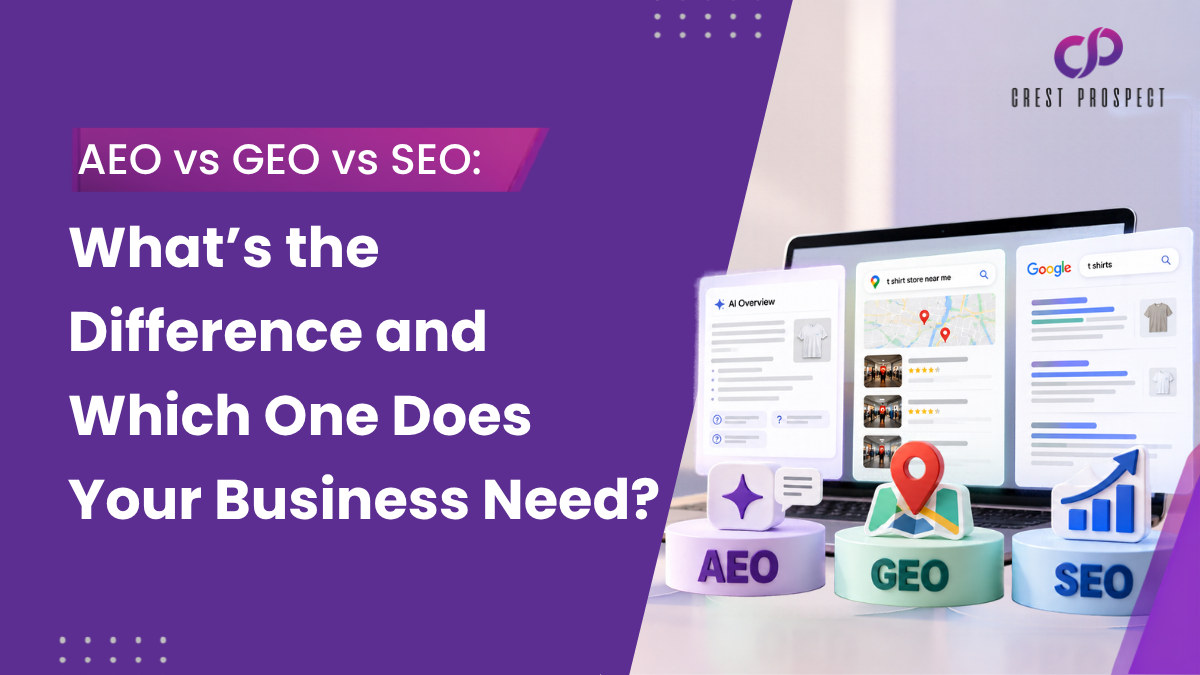
AEO vs GEO vs SEO can sound like three competing marketing strategies, but they are really different ways of improving how people discover and interact with your business. Google says it sees more than 5 trillion searches every year, while AI is expanding the kinds of questions people can ask and how they receive answers.
SEO helps your website get found in traditional search. AEO, or Answer Engine Optimization, focuses on making your content useful as a direct answer to a question. GEO, or Generative Engine Optimization, focuses on improving the chances that your brand and content are surfaced or referenced within AI-generated responses.
That doesn’t mean businesses need three disconnected strategies. The three overlap in important ways. Strong SEO can create the foundation for AEO, while useful content, expertise, authority, and clear context can support GEO.
So, which approach should your business prioritize? Understanding AEO vs GEO vs SEO makes it easier to decide where your resources should go and how these strategies can work together.
AEO vs GEO vs SEO at a Glance
The simplest way to separate the three is to look at the outcome each one is designed to improve.
| Factor | SEO | AEO | GEO |
|---|---|---|---|
| Primary goal | Improve organic search visibility | Become a direct answer | Improve AI search visibility |
| Main environment | Traditional search | Answer-focused search | Generative AI and search |
| Content focus | Relevant, comprehensive content | Clear, direct answers | Useful, authoritative information |
| User behaviour | Search and browse | Ask and receive an answer | Ask AI for a synthesized response |
| Key optimization | Technical SEO, content, authority | Questions, structure, concise answers | Context, authority, original information |
| Main measurement | Rankings, clicks, traffic | Answer visibility, snippets | AI mentions, citations, referrals |
The important part is that these approaches aren’t competing for completely different websites or content. A single page can rank organically, answer a specific question clearly, and contain information that an AI system may consider useful when generating a response.
What Is SEO and What Role Does It Play?
Search Engine Optimization remains the foundation of online search visibility. It helps search engines discover, understand, and evaluate webpages so relevant content can appear when people search for related information, products, or services.
Modern SEO isn’t simply about placing keywords on a page. It involves matching search intent, creating useful content, maintaining technical accessibility, building logical internal links, and establishing authority around important subjects.
Where SEO Creates Visibility
SEO primarily supports traditional organic search visibility. Depending on the business and query, that can include standard organic listings, local results, image results, and other search features.
The basic objective is straightforward: help the right people find your business through search.
This is why SEO still matters in the AEO vs GEO vs SEO discussion. AI-powered search experiences don’t make discoverability irrelevant. Search engines and AI systems still need useful, accessible information to understand businesses, topics, products, and services.
SEO is therefore better viewed as the foundation on which newer search optimization approaches can build.

What Is AEO and How Is It Different From SEO?
Answer Engine Optimization, or AEO, focuses on helping content provide direct answers to the questions people ask.
Instead of thinking only about whether a page can rank for a keyword, AEO asks another question: Can this page clearly answer what the searcher wants to know?
For example, a business targeting “PPC management” could create content around questions such as:
- What does a PPC management company do?
- How much does PPC management cost?
- Is PPC management worth it for a small business?
- How do PPC agencies measure campaign performance?
The content should provide a clear answer before moving into supporting explanations, examples, and details.
Is AEO the Same as SEO?
No. AEO and SEO overlap, but their immediate objectives are different.
SEO focuses broadly on discoverability and organic visibility, while AEO focuses more specifically on being useful as an answer.
AEO still benefits from strong SEO fundamentals. Search intent, crawlability, relevant content, authority, and page structure all matter. The difference is the way the content is shaped around the user’s question and the answer they expect.
So AEO isn’t a replacement for SEO. It adds another layer to an existing search strategy.
What Is GEO and Why Does AI Visibility Matter?
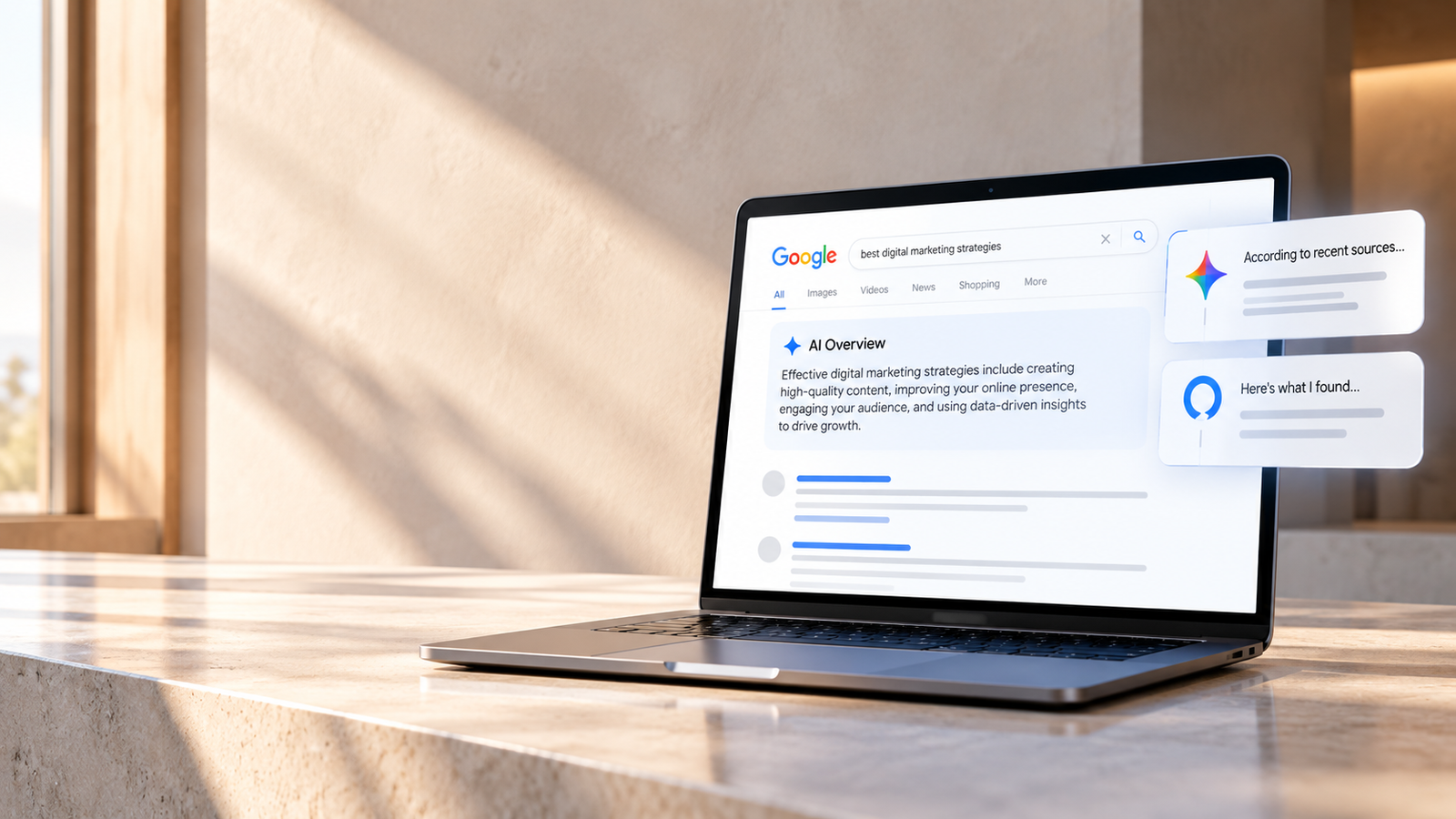
Generative Engine Optimization, or GEO, focuses on improving how a brand’s content can appear within generative AI experiences. Instead of only asking whether a page can rank for a search query, GEO considers whether the information is useful enough for an AI system to understand, include, mention, or reference when generating an answer.
This becomes relevant across experiences such as Google AI Overviews, ChatGPT Search, and other AI-powered search platforms.
What Is GEO Trying to Achieve?
GEO aims to strengthen a brand’s AI search visibility by making its information clear, credible, relevant, and useful as a potential source.
That can involve:
- Original research and data
- Expert insights
- Strong topical coverage
- Clear entity information
- Authoritative references
- Relevant brand mentions
- Well-structured content
However, GEO should not be treated as a guaranteed way to get cited by ChatGPT or appear in every AI-generated answer. AI systems can select different sources depending on the query, context, and information available.
The key difference in the AEO vs GEO vs SEO comparison is the destination. SEO focuses on being discovered in search results. AEO focuses on providing the answer. GEO focuses on improving visibility within generative experiences where AI may synthesize information from multiple sources.

SEO vs AEO vs GEO: What Changes in Practice?
The three approaches become easier to understand when you look at the question each one is trying to solve.
| SEO | AEO | GEO | |
|---|---|---|---|
| Main question | How do I rank? | How do I become the answer? | How do I become a useful AI source? |
| Content approach | Relevant and comprehensive | Direct and structured | Authoritative and contextual |
| Search experience | Search results | Answer-focused results | AI-generated responses |
| User journey | Search → result → click | Question → answer | Prompt → AI response → source |
| Main opportunity | Organic visibility | Answer visibility | AI visibility |
This doesn’t mean you need to create one piece of content for SEO, another for AEO, and a third for GEO.
A strong article can do all three.
For example, a guide about local SEO can be optimized to rank for relevant searches, use question-based sections that provide direct answers, and include original insights or supporting research that makes the content more valuable as an AI source.
The difference is mainly in how you approach the content and what outcome you’re trying to strengthen.
What Should You Optimize for SEO, AEO, and GEO?
Once the distinction is clear, the next question is practical: what actually changes when you optimize for each one?
SEO: Improve Discoverability
SEO optimization should make your website easier for search engines to discover, understand, and evaluate.
Key areas include:
- Search intent
- Technical accessibility
- Relevant content
- Internal linking
- Crawlability
- Backlinks and authority
The focus is on building a strong foundation that allows your pages to compete for relevant organic searches.
AEO: Make Answers Easy to Find
AEO requires a stronger focus on the questions behind searches.
Use:
- Question-based headings
- Direct answers
- Clear definitions
- Lists
- Comparison tables
- FAQs
- Conversational language
Instead of writing a long introduction before answering a question, give the useful answer first and then explain it.
GEO: Create Information Worth Referencing
GEO places greater emphasis on information that can provide value within an AI-generated response.
This can include:
- Original research
- First-party data
- Expert commentary
- Case studies
- Unique examples
- Clear entity relationships
- Authoritative sources
- Relevant brand mentions
The goal isn’t to manipulate an AI system. It’s to make your content a genuinely useful source that has something valuable to contribute.
Is GEO Replacing SEO?
No. GEO is not replacing SEO, and treating it as a replacement can create gaps in your search strategy.
AI systems still depend on information that can be discovered, accessed, understood, and evaluated. That makes the fundamentals of SEO important even when the final user experience happens inside an AI-generated answer.
Think of SEO as the base layer. It helps establish your website’s technical health, content relevance, authority, and search visibility. GEO builds on that foundation by considering how your information can be surfaced within generative search experiences.
For example, a business shouldn’t stop improving its organic rankings simply because customers are also using AI search. Instead, it can strengthen the same content so it answers questions clearly, provides original information, and communicates expertise.
The AEO vs GEO vs SEO discussion isn’t really about choosing the newest strategy. It’s about making your existing search strategy work across more ways of discovering information.
Is AEO the Same as GEO?
No. AEO and GEO have some overlap, but they aren’t interchangeable.
AEO focuses on becoming the answer. It is particularly concerned with questions, direct responses, structured information, and answer-oriented search experiences.
GEO focuses on generative AI visibility. It considers whether your content provides useful, credible information that AI systems may draw from, mention, or reference when producing an answer.
The difference becomes clearer with a simple example.
Suppose a user asks:
“What are the benefits of local SEO for a small business?”
An AEO strategy would make sure your page provides a concise, direct answer to that question.
A GEO strategy would also consider whether the page contains enough useful context, evidence, expertise, and original information to serve as a valuable source for an AI-generated response.
Both approaches benefit from good SEO. That’s why businesses shouldn’t build completely separate content systems for each one.
Do You Need SEO, AEO, and GEO?
For most businesses, the answer isn’t about choosing one and ignoring the others. The better question is which layer needs the most attention right now?
| Business Situation | Priority |
|---|---|
| New website with limited organic visibility | SEO |
| Strong SEO but weak answer visibility | SEO + AEO |
| Content-led business | SEO + AEO |
| Competing heavily in AI search | SEO + GEO |
| B2B or SaaS company | SEO + AEO + GEO |
| Local business | SEO + Local SEO + AEO |
| Established brand seeking broader visibility | SEO + AEO + GEO |
A new website with weak technical foundations shouldn’t jump straight into GEO. Fixing indexing, content relevance, internal linking, and other SEO fundamentals should come first.
A business that already receives substantial organic traffic but rarely appears for question-based searches may benefit more from AEO-focused content improvements.
Meanwhile, an established brand with strong organic visibility may have more reason to explore GEO, particularly if competitors are beginning to appear in AI-generated answers for commercially important topics.
The right combination depends on your business goals, audience behaviour, industry, competition, and current search visibility.
How to Build an SEO + AEO + GEO Strategy
You don’t need three disconnected marketing plans to cover modern search. A better approach is to build one content and search strategy, then optimize different parts of it for the way people search and consume information.
Start With the SEO Foundation
First, make sure your website can be discovered and understood properly. Review technical accessibility, search intent, internal linking, content relevance, site structure, and authority.
If the foundation is weak, adding AEO or GEO tactics won’t solve the underlying problem.
Turn Search Queries Into Questions
Once the SEO foundation is in place, look beyond individual keywords. Identify the questions, comparisons, problems, and conversational searches your audience uses.
For example, a keyword such as “content marketing services” can lead to questions like:
- What do content marketing services include?
- How do content marketing services generate leads?
- How much do content marketing services cost?
- Are content marketing services worth it for small businesses?
These questions can shape pages and sections designed for AEO.
Create Information Worth Referencing
GEO adds another consideration: does your content offer something valuable enough to potentially be used as a source?
Original research, first-party data, expert opinions, case studies, industry observations, and well-supported insights can make your content more distinctive.
Measure Each Layer
Don’t use organic traffic as the only measure of success.
| Strategy | Key Metrics |
|---|---|
| SEO | Rankings, clicks, impressions, organic traffic |
| AEO | Answer visibility, featured snippets, answer-driven clicks |
| GEO | AI mentions, citations, AI referral traffic |
The goal is to understand how your visibility is changing across different search experiences.
One Business, Three Search Strategies
Consider a B2B cybersecurity company selling compliance software. The same business can approach its search strategy from three angles without creating three separate campaigns.
SEO
Target a search such as “cybersecurity compliance software” and create a useful page designed to compete in organic search.
AEO
Answer a question such as “What does cybersecurity compliance software do?” with a concise explanation followed by practical details.
GEO
Build authoritative content around a question such as “What cybersecurity compliance platforms are suitable for mid-sized businesses?” Include original insights, product information, expert commentary, comparisons, and supporting evidence.
The content supporting these searches can overlap. What changes is the way you structure and develop the information.
That’s the real value of understanding AEO vs GEO vs SEO. You aren’t choosing three competing paths. You’re creating a broader search strategy that can meet users wherever they look for information.
Why Crest Prospect Takes an Integrated Search Approach
Search isn’t limited to one results page anymore. Businesses need content that can perform in traditional search while also answering questions and supporting visibility across emerging AI experiences.
Crest Prospect brings SEO, AEO, and GEO together through search strategy, content development, technical optimization, entity-focused content, and AI visibility analysis.
Instead of creating three disconnected campaigns, the focus is on building one search ecosystem around your audience, their questions, and the topics that matter to your business.
Want to see where your business stands across traditional and AI search? Book a free SEO + AEO + GEO strategy call with Crest Prospect.
Conclusion
The AEO vs GEO vs SEO debate isn’t really about picking one strategy and leaving the others behind. Each approach addresses a different part of the modern search journey.
SEO helps your business get discovered. AEO helps your content provide direct answers to important questions. GEO helps strengthen your chances of being surfaced or referenced within generative AI experiences.
For most businesses, the strongest approach is to build on a solid SEO foundation, identify the questions your audience asks, and create useful information that can work across both traditional and AI-powered search.
The right strategy depends on where your business is today and where your customers are searching.
AEO vs GEO vs SEO FAQs
1. What is the difference between AEO, GEO, and SEO?
SEO focuses on organic search visibility, AEO focuses on becoming a direct answer, and GEO focuses on improving visibility within generative AI search experiences.
2. Is AEO the same as GEO?
No. AEO focuses primarily on answering user questions, while GEO focuses on making content useful for AI-generated responses, including potential mentions and citations.
3. Is GEO replacing SEO?
No. GEO builds on many SEO fundamentals. Technical accessibility, relevant content, authority, and search visibility remain important for a modern search strategy.
4. Does AEO replace traditional SEO?
No. AEO complements SEO by making content more useful for answer-focused searches. A strong SEO foundation can support both traditional rankings and answer visibility.
5. Which is more important, SEO or GEO?
It depends on the business. SEO should generally remain a core foundation, while GEO becomes increasingly useful for businesses that want to improve visibility across AI-powered search experiences.
6. How does AEO help businesses appear in AI-generated answers?
AEO encourages businesses to answer specific questions clearly using concise explanations, descriptive headings, structured information, and useful supporting details.
7. Does GEO guarantee ChatGPT or AI citations?
No. There is no guaranteed method for securing citations in ChatGPT or other AI-generated search experiences. GEO focuses on improving the quality and relevance of information that AI systems may use.
8. How do you measure AEO and GEO performance?
AEO can be measured through answer visibility, featured snippets, and answer-driven traffic. GEO can be evaluated through AI mentions, citations, source visibility, and referral traffic from AI platforms.
9. Do small businesses need SEO, AEO, and GEO?
Small businesses should prioritize based on their current visibility and goals. SEO is usually the foundation, while AEO and GEO can be added where customer behaviour and search opportunities justify them.
10. How can a business create an SEO, AEO, and GEO strategy?
Start with strong SEO foundations, identify the questions customers ask, structure content around those questions, publish authoritative information, and track visibility across traditional and AI-powered search.